Differentiate teaching materials around one objective
Vary support and challenge while keeping the intended learning visible in every version.
WordPilot · Updated
- Best for
- Vocabulary · 8–11
- You provide
- A few minutes to follow the method
- You get
- A practical method with an example to review
Name the barrier, not a label
Describe what makes the activity difficult: unfamiliar vocabulary, several instructions at once or a demanding response format. Do not upload sensitive learner profiles. In the weather example, all learners practise the same four words, but the amount of sentence support changes.
Request three purposeful versions
The supported version uses matching and a sentence starter. The independent version asks learners to use and compare words. The extension version asks for a connected forecast. More questions alone would not create this progression. Ask the agent to explain how each version retains the same objective.
Compare and adjust
Place the versions side by side. Check that the supported task still requires thinking and that the extension does not introduce untaught content. Let learners move between supports when appropriate. After use, revise the materials using observed responses rather than fixed assumptions about ability.
What the finished resource can look like
One vocabulary objective with supported, independent and extension activities.
- Subject
- Vocabulary
- Suggested age
- 8–11
- Use weather words in context
- Keep the same goal with different support
Original WordPilot example, reusable and adaptable for classroom use. No official curriculum alignment claimed. Review and adapt for your learners.
Open and adapt the resource
Answer key / marking guidance
- forecast
- A drizzle is light rain; a storm can include strong wind and heavy rain.
- Accept accurate contextual use. Extra challenge should deepen the same vocabulary goal.
View the example material screenshot
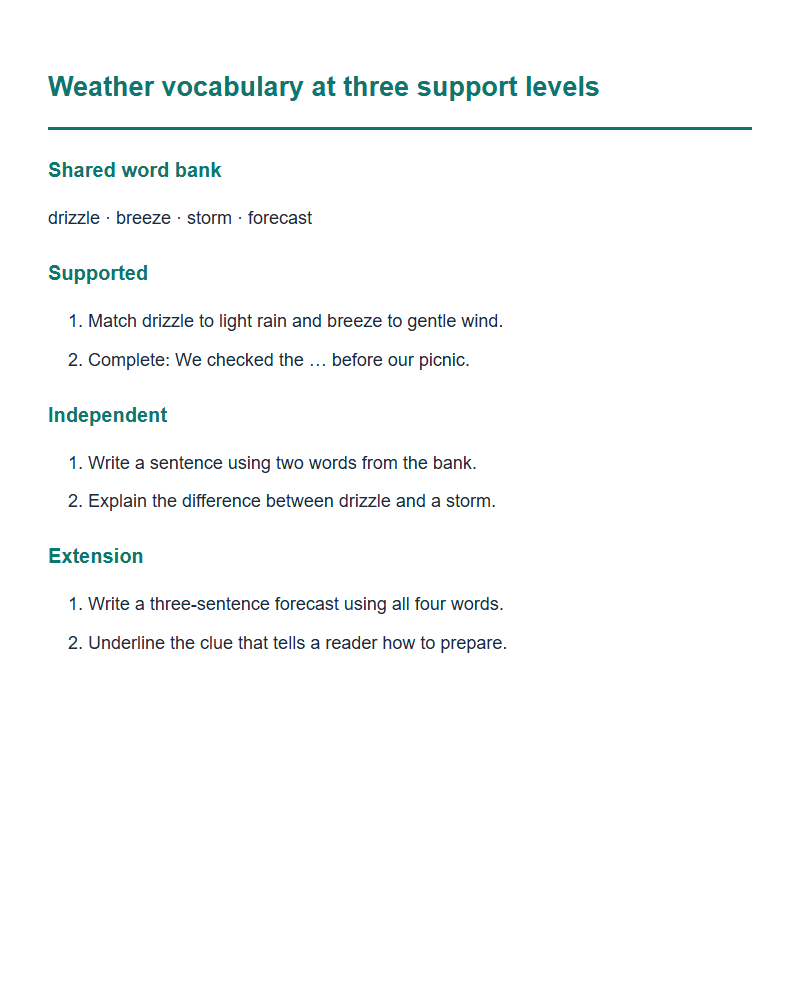
Screenshot of the example content, not the application interface.